
Nigerian Stocks Gain ₦1.29 Trillion as Banking and Oil Shares Rebound
Nigeria’s stock market surged by ₦1.29 trillion as renewed investor interest in banking and oil stocks pushed the NGX All-Share Index higher.




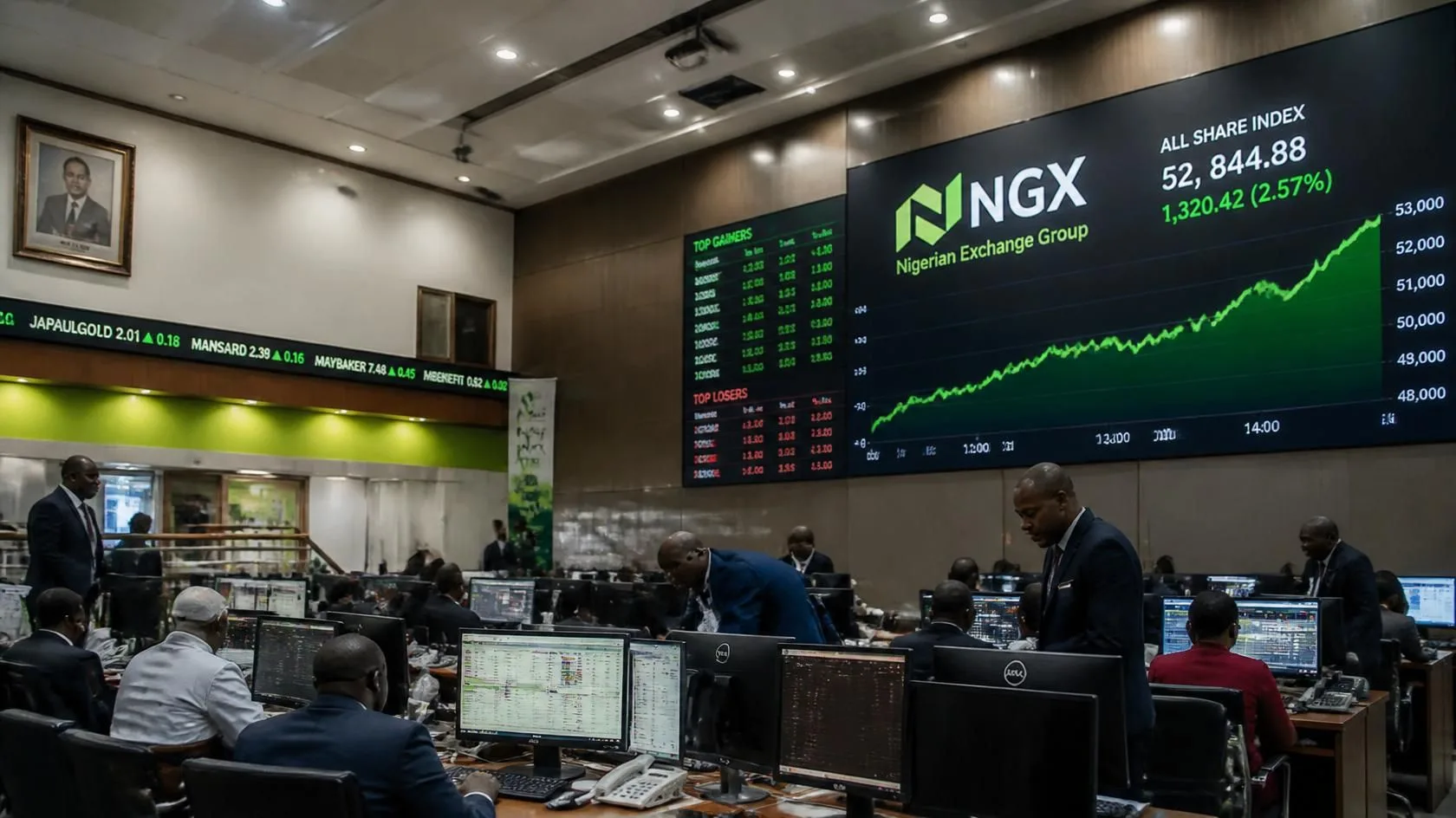
The Nigerian stock market just delivered a massive win for investors. Equities gained approximately N1.29 trillion in market capitalisation last week. This fresh momentum pushed the total market value to a staggering N155.83 trillion. If you closely watched the NGX today or throughout the week, you noticed a clear shift in momentum. The NGX All-Share Index climbed 0.81% week-on-week, settling at 241,298.47 points. This upward swing successfully reversed the losing streak from the previous week. Buyers aggressively returned to the trading floor. They specifically targeted heavyweight companies in the banking and energy sectors.
FTSE Russell Reclassification Sparks Buying
What triggered this sudden wave of buying? A major catalyst was the news from global index provider FTSE Russell. They recently confirmed Nigeria's impending reclassification from unclassified to frontier market status. This upgrade takes effect in September 2026. It serves as a huge vote of confidence in the country's ongoing economic reforms.
You can read more about how the FTSE Russell reclassifies Nigeria frontier market move impacts foreign exchange liquidity. International investors use these classifications as a core benchmark for portfolio allocations. Knowing Nigeria is back on the frontier market map gave local investors the green light to take positions in undervalued Nigerian stocks. The timing of this upgrade is perfect. For the past year, foreign exchange volatility kept many offshore funds away from Nigerian assets. The central bank's recent efforts to stabilize the naira are working. Dollar liquidity is gradually returning to the official FX windows. Foreign fund managers are taking notice. The FTSE Russell announcement acts as an independent validation of these policy shifts. It signals to the global investment community that Nigeria is open for business and ready to handle large capital inflows.
Banks and Oil Companies Drive the Index
Let's break down the sector performance, starting with the banks. Financial stocks remain the absolute engine of the Nigerian Exchange Group. The Banking Index jumped 2.85% last week. This was not a broad stroke of luck. Investors surgically picked tier-one Nigeria banking stocks with strong fundamentals and clear recapitalisation roadmaps. First Holdco was a standout performer, surging 11.58% to close at N145 per share. Access Holdings followed closely, advancing 9.26% to reach N29.50. United Bank for Africa (UBA) also saw renewed buying interest.
These large-cap banks carry significant weight on the exchange. When they move, they pull the entire benchmark index up with them. The heavy concentration of trading in financial services accounted for roughly 78.87% of the total equity turnover volume. Banks are currently in the middle of a massive recapitalisation drive mandated by the central bank. Many feared this exercise would dilute shareholder value. Instead, investors are buying into the long-term vision. They believe these banks will emerge stronger, better capitalized, and capable of funding massive infrastructure projects.
The energy sector provided even stronger support for the broader market recovery. The NGX Oil/Gas Index surged by 4.54%. Seplat Energy single-handedly carried much of this weight. Its share price skyrocketed by 10% to close at an impressive N12,320.60. Investors are pricing in the benefits of recent regulatory shifts and corporate expansions. The government's broader Nigeria oil and gas reforms are creating a more favorable environment for listed energy firms to operate efficiently.
It wasn't a clean sweep for all oil stocks Nigeria hosts. Trading remains highly stock-specific. While Seplat investors celebrated, TotalEnergies Marketing Nigeria shareholders watched their stock drop by 10%. This sharp divergence proves that buyers aren't blindly throwing money at the energy sector. They are scrutinizing individual corporate fundamentals and earnings outlooks before committing capital.
Weak Market Breadth Shows Selective Buying
Despite the trillion-naira gain, the rally had a distinct flaw. Market breadth remained surprisingly weak. A healthy bull run usually lifts the majority of listed companies. Last week, 55 equities recorded price declines. Only 24 stocks managed to post gains, resulting in a negative breadth ratio. Another 68 stocks flatlined, seeing zero price movement. This confirms the market's advance was heavily concentrated. A handful of large-cap banking and oil stocks did all the heavy lifting. The broader market actually struggled to find its footing.
Trading activity also took a noticeable dip. You might expect a N1.29 trillion gain to be backed by massive trading volumes. That wasn't the case. Total transaction volume fell by nearly 60% week-on-week. Investors exchanged 2.51 billion shares valued at N123.37 billion across 173,848 deals. This drop in volume suggests many retail investors chose to sit on the sidelines. The smart money quietly accumulated choice assets while the wider retail crowd hesitated. This low-volume rally indicates cautious optimism rather than outright market euphoria.
Sectors Left Behind
Not every sector joined the party. The insurance sector actually declined by 1.27% last week. Losses in stocks like International Energy Insurance and SUNU Assurances Nigeria dragged the index down. The industrial goods sector also slipped slightly by 0.15%. Investors took profits in companies like Cutix and Austin Laz after previous rallies. This sector rotation is completely normal in a maturing market. Funds constantly move from overbought segments into areas offering better short-term value.
Investors are also keeping a close eye on interest rate yields. The central bank's monetary policy decisions heavily influence equity allocations. When fixed-income yields rise, stocks usually suffer as capital flows to safer government bonds. Right now, equities are holding their own. The impressive dividend yields and capital appreciation offered by top-tier Nigerian stocks provide a solid hedge against inflation. This dynamic explains why domestic institutional investors continue to increase their equity exposure despite tight monetary conditions.
What This Means for Investors
Look at the wider landscape of the stock market Nigeria 2026. The performance of the Securities and Exchange Commission and the NGX in stabilizing the platform is bearing fruit. The year-to-date return now stands at a massive 55.06%. For anyone who bought a diverse portfolio of fundamentally sound Nigerian equities in January, the returns have easily outpaced domestic inflation. The consumer goods sector also pitched in last week, advancing by 2.93%. Brands like University Press recorded massive gains, appreciating 18.75% to lead the gainers' chart. Transcorp Hotels and Red Star Express also posted near 10% gains,. This shows that pockets of value still exist outside the dominant banking and oil sectors.
What should investors expect in the coming weeks? The upcoming reclassification by FTSE Russell will likely attract foreign portfolio investors back to Lagos. These institutional buyers typically target highly liquid, large-cap stocks. We expect banking and energy shares to remain in the spotlight. The weak market breadth is a warning sign. You cannot rely on index momentum alone. Stock selection is more critical now than at any point this year. Buying fundamentally strong companies at reasonable valuations will protect your portfolio if the large-cap rally stalls.
Retail investors need to adapt their strategies. The days of buying any stock and expecting it to rise are over. The current market heavily favors companies with solid cash reserves and low dollar-denominated debt. Companies that can maintain their dividend payouts despite inflationary pressures will command premium valuations. As the NGX heads deeper into the final quarter of 2026, the focus will shift entirely to full-year earnings expectations.
The Nigerian stock market is proving its resilience. Gaining over a trillion naira in a single week shows the depth of local liquidity when sentiment turns positive. The macroeconomic environment remains challenging, but corporate earnings from top-tier firms remain robust. If the major banks complete their capital raising exercises successfully, we could see another wave of sustained buying. For now, the bulls are back in control of the NGX, driven by the heavyweights of the banking and oil sectors.
Comments (0)
Keep exploring
Related posts
 Business
Naira Dips, Hits ₦1,382 per Dollar in Parallel Market
 Business
Dangote Refinery Plans $1.5 Billion IPO: What Investors Need to Know
 Business
FTSE Russell Reclassifies Nigeria to Frontier Market
 Business