Rooftop Solar Fires Plague Nigerian Homes Amid Power Woes
Rooftop solar fires are destroying Nigerian homes as families rush to escape the collapsing power grid. Learn how fake equipment and bad installers cause these deadly blazes.



Nigerians are desperately seeking an escape from total darkness. The national grid collapses almost weekly. Running a petrol generator is no longer a viable backup plan. With petrol prices surging past 1,400 Naira, keeping the lights on feels like a luxury most families can no longer afford.
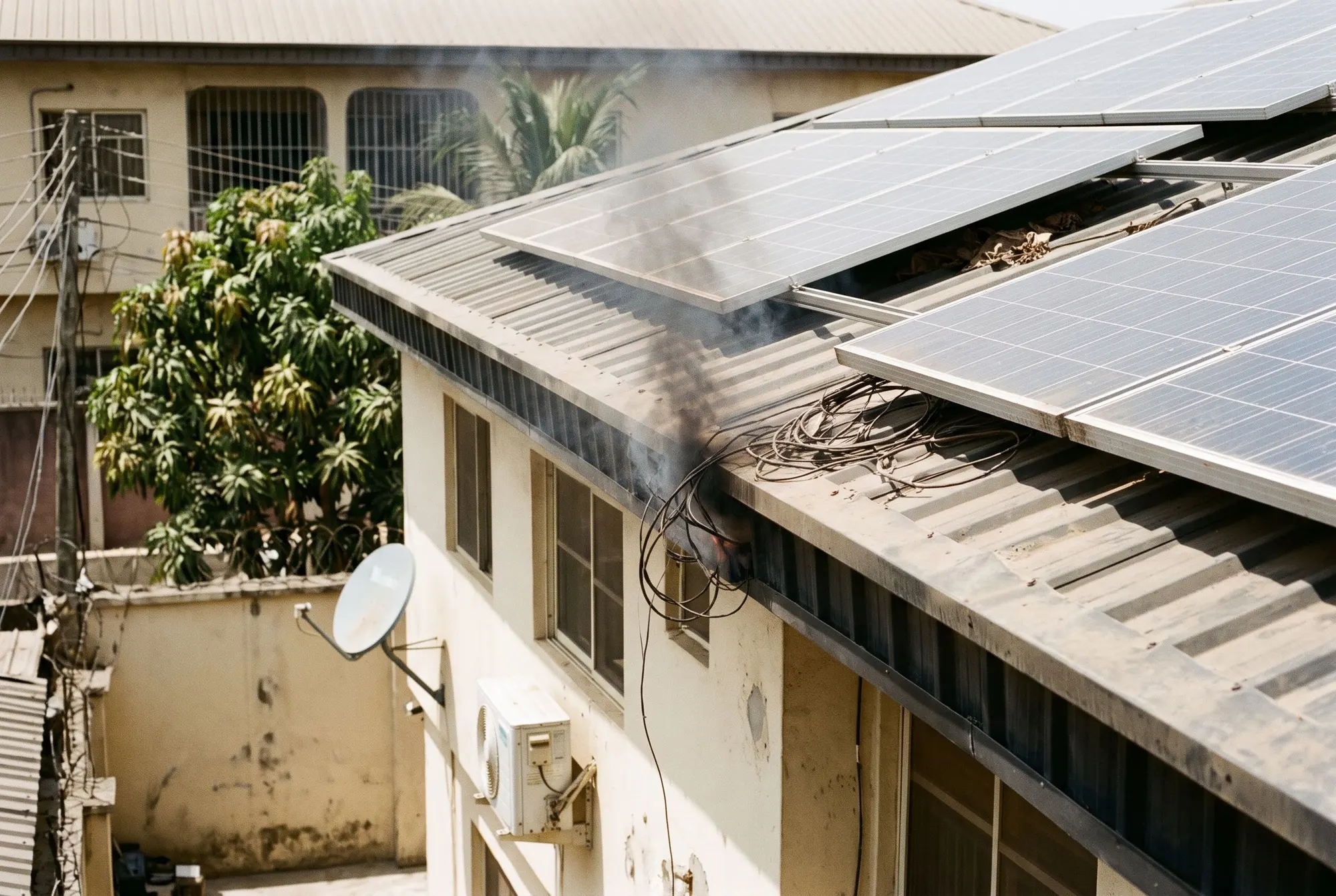
Millions of households are now turning to rooftop solar panels and inverters. It makes perfect financial sense. You harness the sun, cut out the generator noise, and completely escape the fuel queues. But this mass migration to renewable energy hides a deadly new problem. Rooftop solar fires are sweeping through residential neighborhoods across the country.
We are trading power woes for severe fire hazards. The core issue isn't the solar technology itself. The real danger lies in substandard equipment and unqualified installers.
Walk through any major electronics market in Lagos or Kano today. You will see hundreds of unbranded solar panels and generic lithium batteries stacked high. The Naira recently dipped to 1,382 against the dollar. This massive currency devaluation makes premium, Tier-1 solar equipment completely unaffordable for the average family.
Instead of waiting, buyers settle for cheap knockoffs. They purchase recycled batteries labeled as brand new. They buy low-grade inverters with faulty internal cooling systems. When you push heavy electrical loads through this fake equipment, it overheats rapidly.
The biggest culprits behind these fires are the overnight "solar engineers." The soaring demand for solar power created a massive skills gap. Roadside electricians are suddenly rebranding themselves as renewable energy experts to grab quick cash.
Solar installations require precise mathematical calculations. You must match the cable thickness to the direct current (DC) voltage coming from the batteries. Many unqualified installers use standard alternating current (AC) house wires for these heavy battery connections. DC current generates immense heat. When thin, incorrect wires carry this heavy load, their insulation melts. A spark catches the wooden roof beams, and the entire house goes up in flames.
Furthermore, these rogue installers frequently skip essential safety components to make their quotes look cheaper. They ignore DC circuit breakers and proper earthing rods. If a power surge hits the panels, there is nothing to stop the excess voltage from frying the batteries inside your living room.
Lithium-ion batteries require extreme care. When they overheat, they enter a dangerous state called thermal runaway. This chemical reaction feeds on itself and creates fires that are notoriously difficult to extinguish with water. The National Fire Protection Association (NFPA) strictly warns against using uncertified lithium batteries or mismatched charging systems. A cheap, fake solar charge controller can easily overcharge a battery until it literally explodes.
If you are planning to install solar or already have a system, you must verify its safety. Don't just trust the installer's word blindly.
Solar Component | Safety Standard | Risk of Ignoring |
Battery Cables | Thick, pure copper DC-rated cables | Overheating, melting insulation, instant fire |
Circuit Breakers | Dedicated DC breakers between panels and inverter | Power surges destroy equipment and spark flames |
Charge Controller | MPPT controller matching battery chemistry | Overcharging leads to battery swelling and explosion |
Earthing (Grounding) | Deep copper rod connected to panel frames | Lightning strikes can burn the entire system |
Switching to solar power is still the smartest move for Nigerian households. The silence and steady power will transform your daily life. You just cannot afford to cut corners on the installation process.
Save up and buy genuine equipment with verifiable warranties. Hire certified professionals who truly understand load balancing and battery chemistry. Paying an extra hundred thousand Naira for proper cables and breakers hurts your wallet right now. Watching your family home burn to the ground will cost you absolutely everything. Take the time to do it right and keep your family safe.
Comments (0)
Keep exploring
Related posts
 News
Nigerians Face El Nino Heatwave with Jokes and Warnings
 News
Melania Trump Helps Broker Russia-Ukraine Ceasefire
 News
Mistaken Bank Transfers: Refusing to Refund Risks Jail
 News